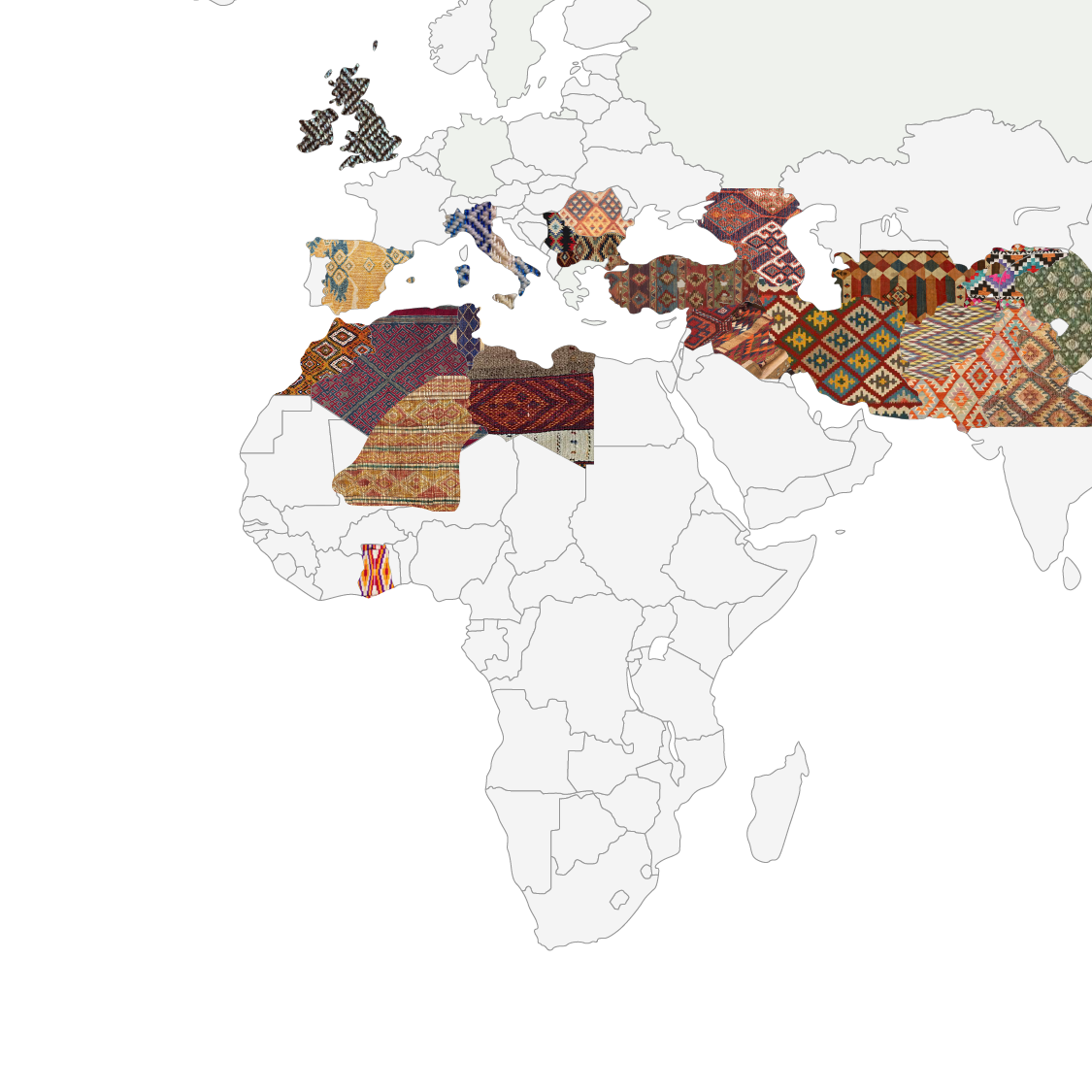
From the heart of China along the Silk Roads towards the Mediterranean and the edges of the Atlantic, these territories have seen much exchange of knowledge, craftsmanship, and textile innovation
Clicking on the photos will take you to the original website the photo originates from. (where available)
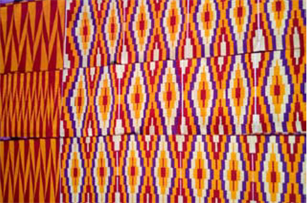
Ghana. “Nyame ne ma anidasoɔ” = “God is my hope”. Cotton Kente fabrics. Woven in 20-25cm long strips, then sewn together. Rights @Armah, L., Adjei, D., Menetey, B., and William, K. Accessed via https://www.scirp.org/journal/paperinformation?paperid=127236. More info at https://kentecloth.com/blog/kente-cloth/
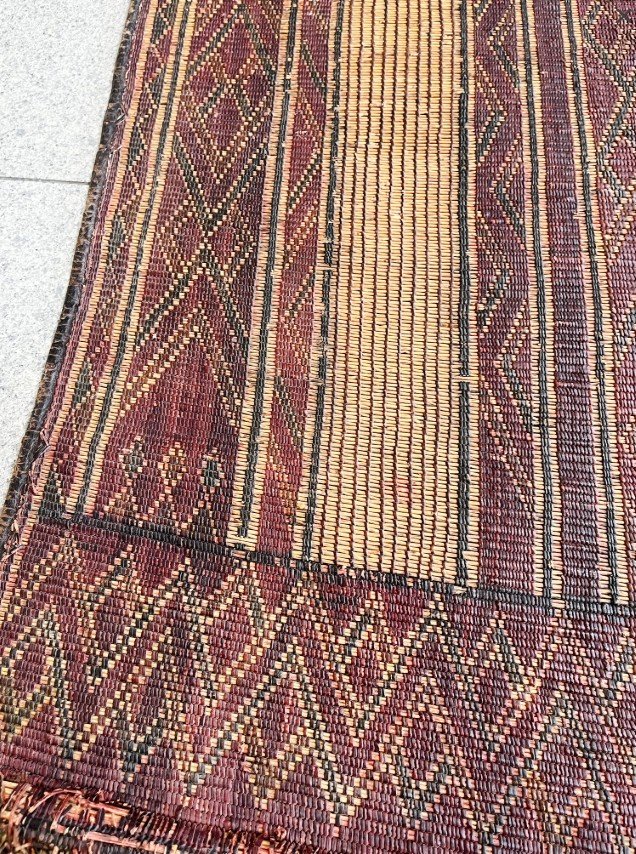
Saharan Desert. 20th-century Tuareg woven rug made of leather and reed. Dimensions 132cm x 88cm. The design consists of diamond and linear patterns in an earthy palette of browns, dark reds, black, and straw yellow. Rights Cafiero Select. Accessed via https://cafieroselect.com/products/tuareg-woven-leather-reed-rug
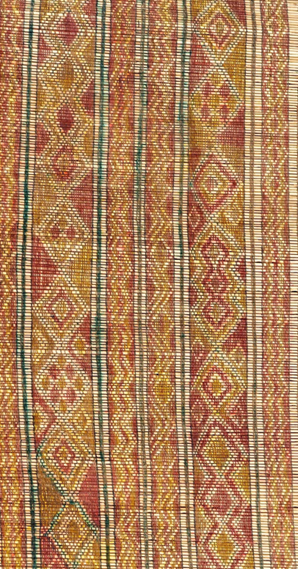
Mauritania. Large Mauritanian Rug. 10' x 7'2" This Moroccan Mauritanian (Tuareg) leather mat is made of dwarf palm tree fibres and handwoven with leather stripes. The beautiful design is typical of the northern African culture that created it, the Tuareg tribes from Mauritania. Accessed via https://creelandgow.com/product/mauritanian-tuareg-rug-10-x-72/?srsltid=AfmBOop2dRfB50G9AmI-LxWpqsZs4IHw5Ylr8dkTCXtAyhJUAqxcH_VDv
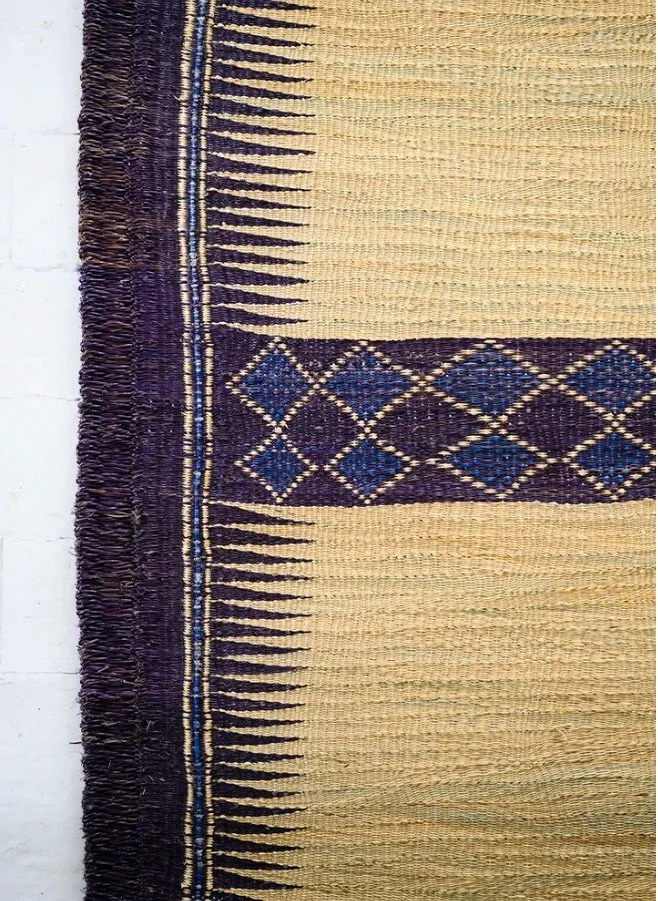
Tunisia. Halfa Rugs. Halfa grass, known also as esparto grass (Stipa tenacissima). Made by the artisans of the H’ssir El Halfa collective in the Kasserine Region of Western Tunisia, not far from the Algerian border.Border dyed in indigo. Rights Flint & Kent. Accessed via https://www.flintandkent.com/tunisian-halfa-rugs
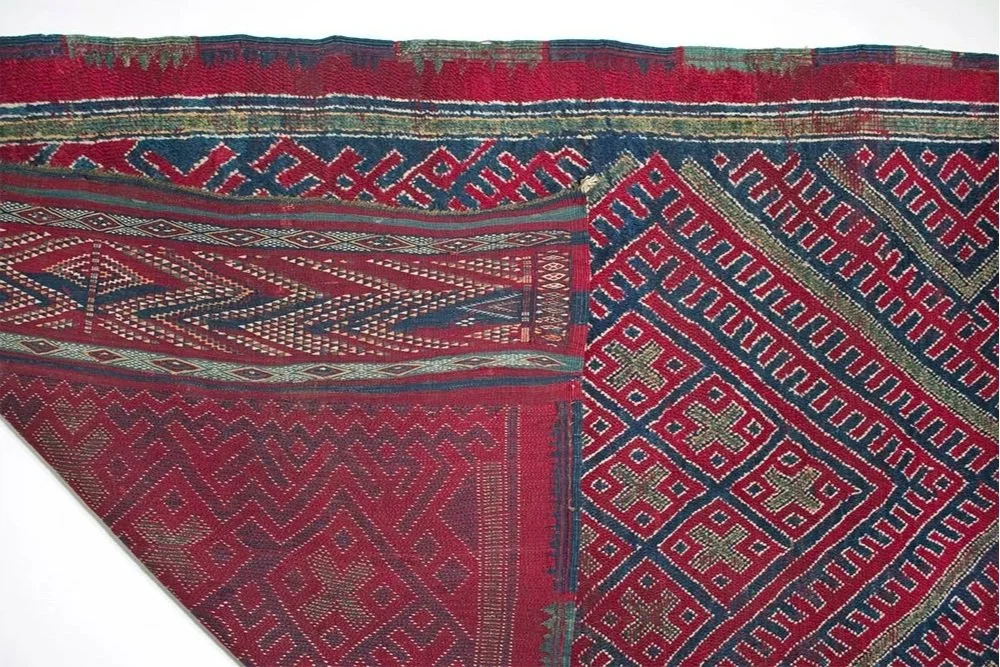
Algeria. Detail of an Jebel Amour rug, 19th century or earlier. 1.65m x 5.50 m. Made under the guidance of a male master weaver, an approach that is widespread in Algeria. In Morocco, it is encountered mainly in parts of the Middle Atlas, the Moulouya Valley, and some eastern areas near the Mediterranean coast. The Master Weaver (Arab. reggâm) was responsible for the patterning, while female weavers had the task of filling in the pile in the specified colours within the marks set by the reggâm. The master’s marks were set with white knots, which appear as white contour lines in the pattern of the carpet. In many eastern Moroccan carpets, where the influence of Jebel Amour carpets is plain, such white contour lines also appear as a decorative element, but they have quite obviously lost their function as design markers. Photo by Gebhart Blazek, Graz/Alberto Levi Gallery, Milan. Public domain. Accessed via https://commons.wikimedia.org/wiki/File:Algerian_Jebel_Amour_rug,_19th_century_or_earlier_%28detail%29.png
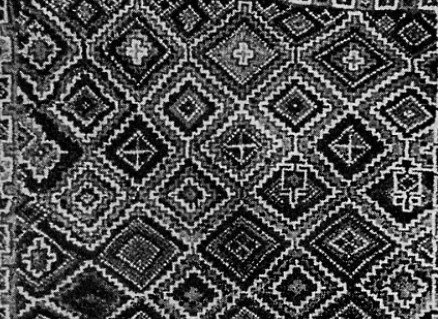
Morocco. Beni Mguild tribe. Tarfaft – covering for the bottom of the tents. Wool. Used by permission of Fonds Germaine Laoust-Chantréaux. Tissages marocains. Accessed via https://cinumed.mmsh.univ-aix.fr/viewer/78323/?offset=#page=1&viewer=picture&o=info&n=0&q=
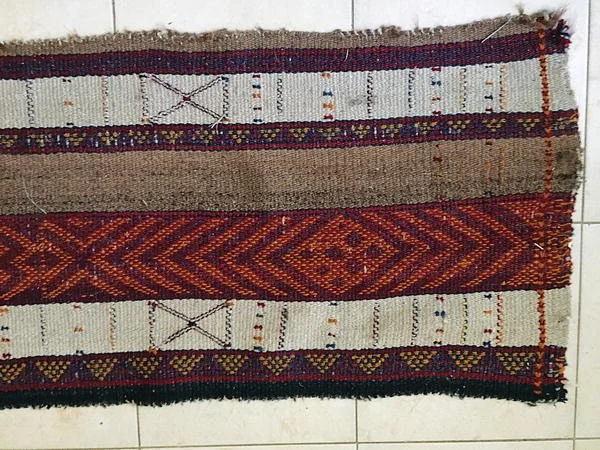
Libya. Bedouin tent cover. The weaving art, composing the customary Bedouin tent, is portrayed as steadily disappearing. With the discovery of immense oil reserves by 1959, the Libyan tribal system and economy gradually evolved, leading impoverished nomads and semi-nomads to quit the rangelands life for financially more secure but humble employment. Foto Gustave Gintzburger, Slim Saïdi. Accessed via https://doi.org/10.1079/9781800627154.00
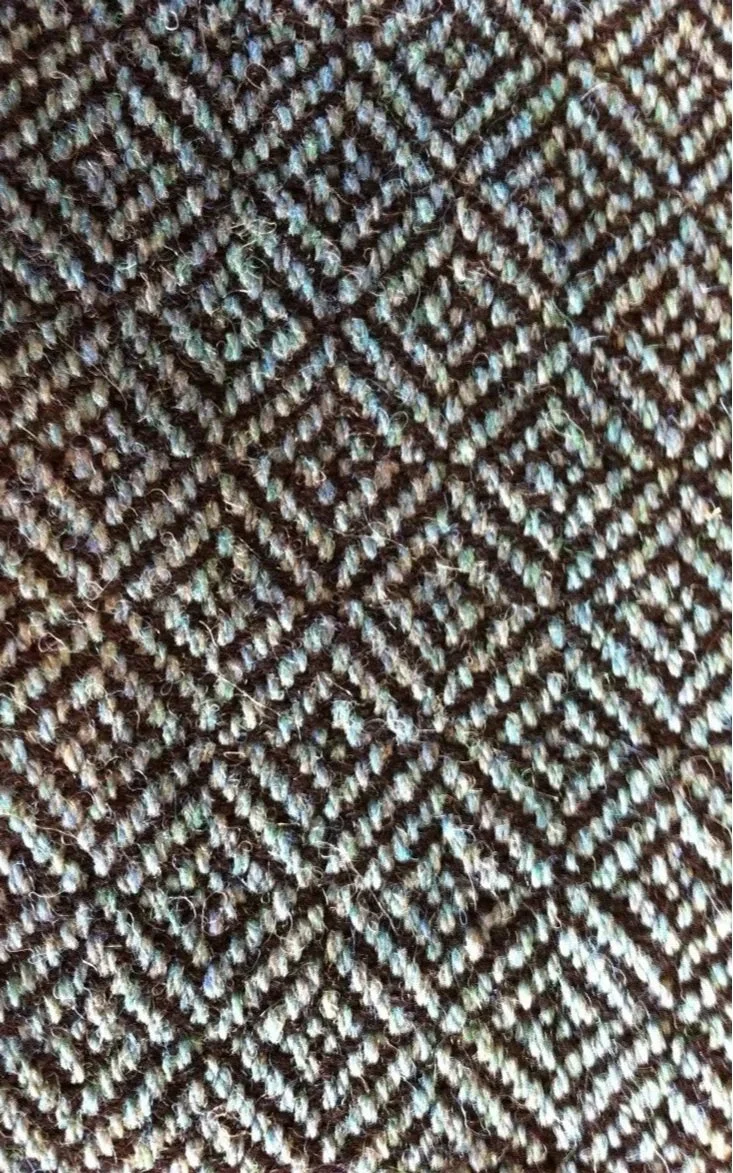
Celts. Broken Diamond or Lozenge Twill. Before the Romans introduced the vertical two-bar loom, with the warp anchored at both ends, this was the only way to weave a concentric diamond pattern on a warp-weighted loom. Rights @Sally Mc Lean. Accessed via https://celtic-weaving.com/2015/08/30/diamonds-and-broken-diamonds/
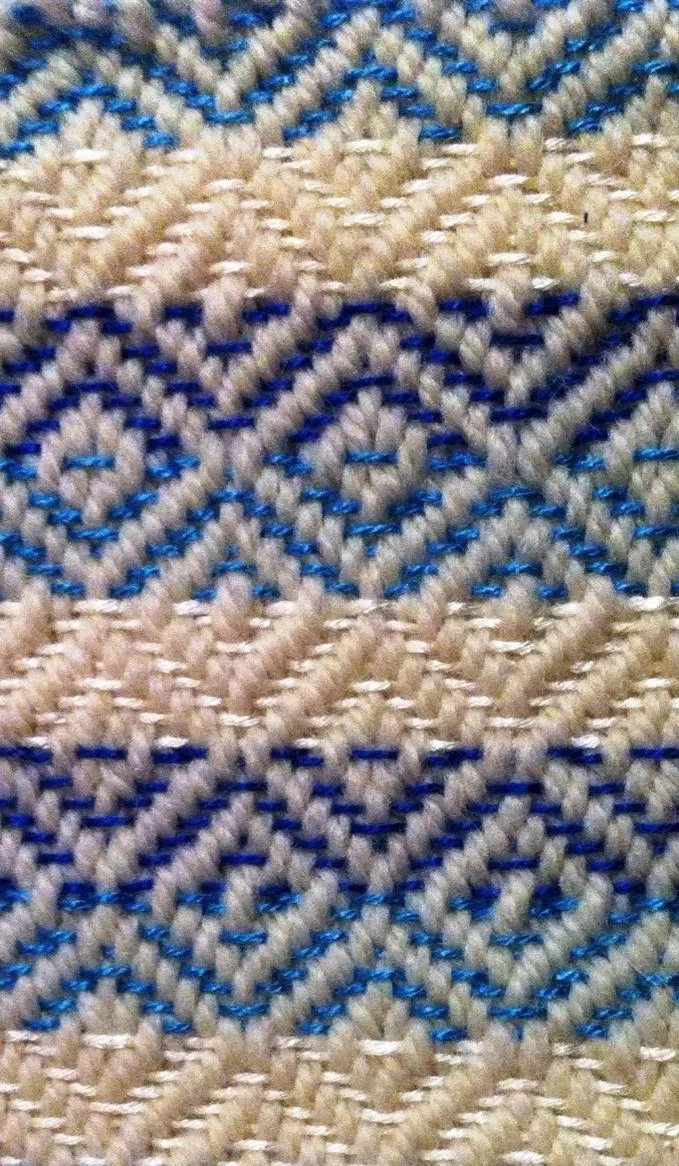
Roman Empire. The diamond twill. Woven on two-bar looms. Wool and Cotton. Rights @Sally Mc Lean. Accessed via https://celtic-weaving.com/2015/08/30/diamonds-and-broken-diamonds/
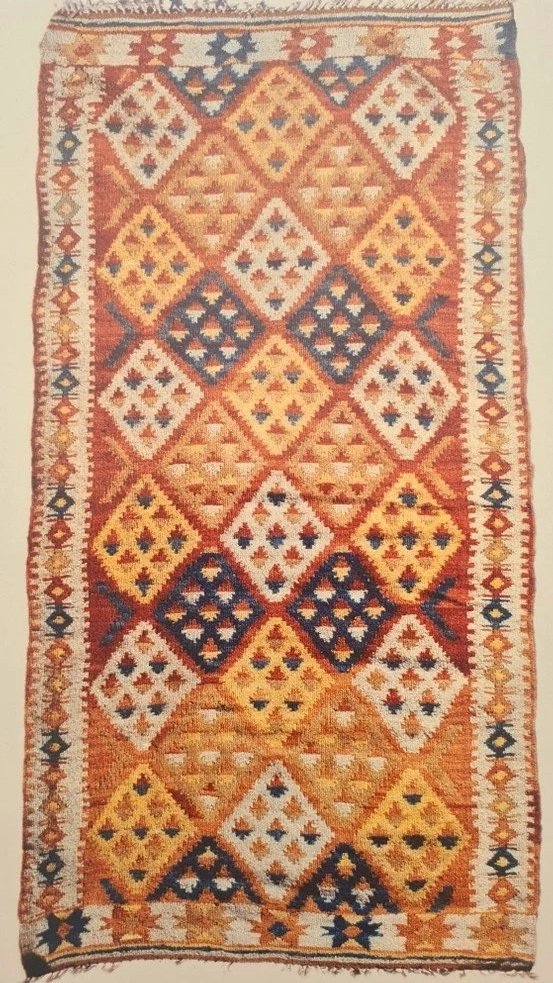
Romania. Scoarță from Maramureș region. Dimensions unknown. Wool. Latter 19th Century. Part of the Collection of the National Peasant’s Museum in Bucharest. Inv.099. Foto Viorel Simionescu, Cori Simona Ion. Used by permission of MTR Bucharest.
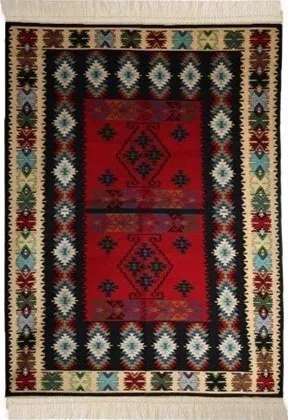
Serbia. Certified original Pirot kilim, handmade, with protected geographical origin. Dimension 1.4 x 1.92 m. Wool sourced from the Pirot Pramenka sheep breed. 6 warp threads per cm and 28 weft passes per cm. Rights @Kilim Arts & Crafts, Serbia. Accessed via https://kilim.rs/en/product/heir-to-the-throne-2021/
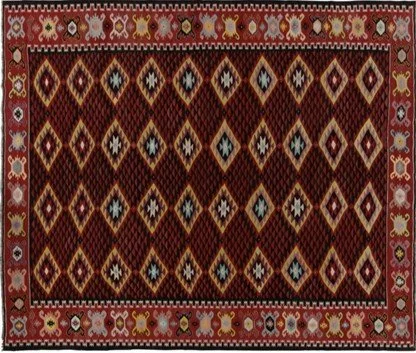
Macedonia. 1920s Vintage Macedonian Kilim in Red, Black and Pink Geometric patterns. Dimension 10x12 . Handwoven wool. Ca 1920-1930. Rights @Rug&Kilim. Accessed via https://rugandkilim.com/product/kilim-flat-weave/1920s-vintage-macedonian-kilim-in-red-black-and-pink-tribal-geometric-patterns/?srsltid=AfmBOorr73_XADTtKlH9m8CayvJzWweVPF-sdA-DxeydTi56hA9htFQB
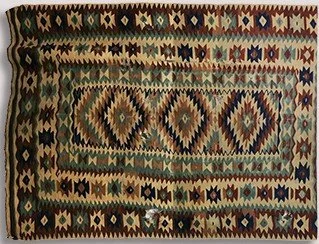
Bulgaria. Chiprovtsi flat weave carpet. Bakam Pattern. Chiprovtski weaving is classified as UNESCO intangible heritage. Dimensions unknown. Wool. Rights @Elisa Rugs. Accessed via https://elisarugs.com/rug-making-history
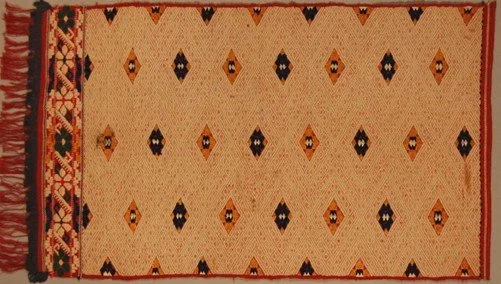
Bulgaria. Sliven. Apron in cotton and Silk. Dimensions 97 x 54 cm. Plain and twill weave with embroidery. The ground is made from red tabby woven cotton cloth, which is almost completely covered with a cream-coloured diamond twill pattern. This is embroidered using stranded single cotton. The centres of diamonds left free of cotton decoration are embroidered with yellow, blue and white silk thread. Near the hem is a line of large floral motifs, worked mainly in cream, but also in green, blue and pink cotton threads. The hem has a red plied fringe and blue applied crochet (?) trim. The ties are missing. Rights @the Trustees of the British Museum, London. Accessed via https://www.britishmuseum.org/collection/object/H_Eu1971-01-74?selectedImageId=184073001
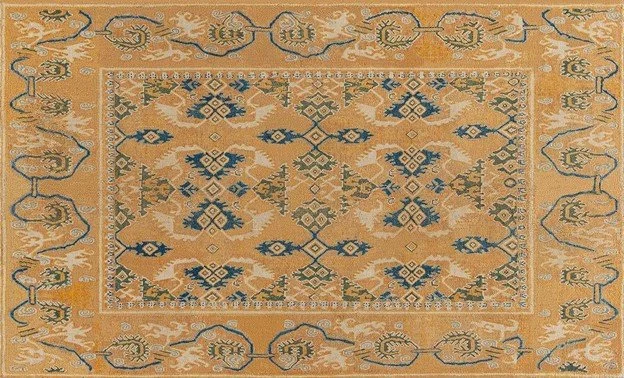
Spain. Vintage Spanish Cuenca Rug (Size Adjusted). Dimension 215 × 342 cm. Wool. Rights @Doris Leslie Blau. Accessed via https://www.dorisleslieblau.com/vintage-spanish-cuenca-rug-11x7-bb7785/?srsltid=AfmBOookZDW2UzvDLuWEJjd5kVhqYzyB-LQOpKV8Y0HYoIUyohN1dn1o
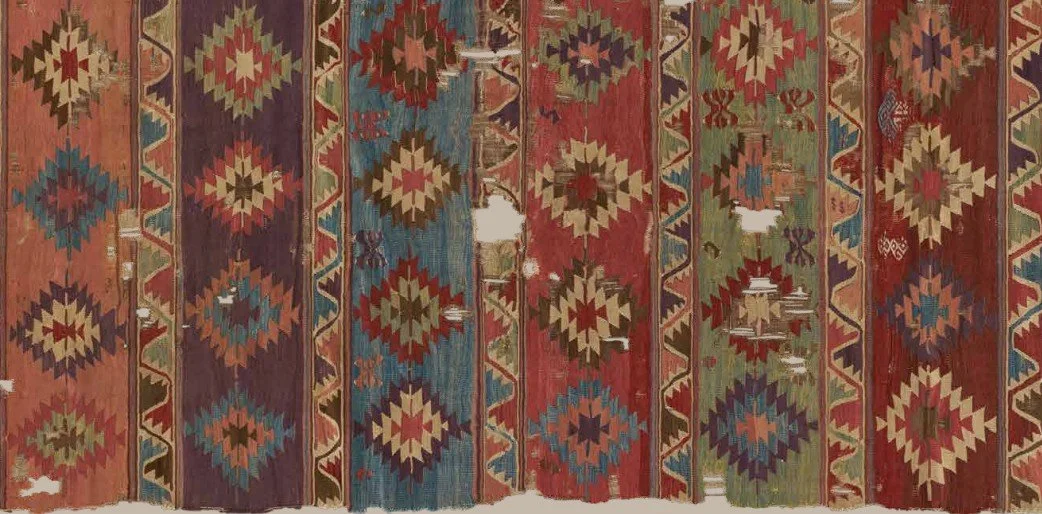
Central Anatolia. Kilim. Early 19th century. Dimensions: 137 x 387cm. Wool. The Textile Museum 2013.2.31. The Megalli Collection. Foto Niel Greentree. Rights George Washington University Museum and The Textile Museum
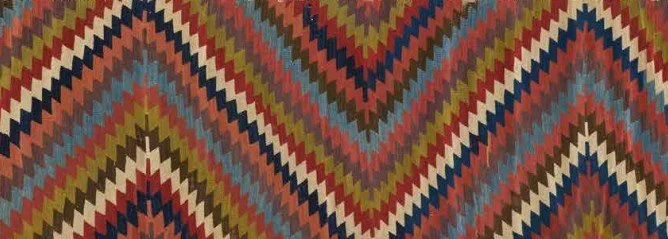
Central Anatolia. Kilim. Mid-19th century. Dimensions: 444.5 x 74cm. Wool. The Textile Museum 2013.2.19. The Megalli Collection. Foto Niel Greentree. Rights George Washington University Museum and The Textile Museum
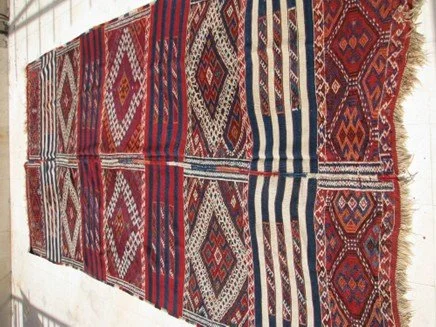
Syria. Kurdish Aleppo kilim. Dimension 145 cm long. Wool. Early 20th century. Rights of Oriental Rugs & Carpets. Accessed via https://orientalrugandcarpet.com/syrian-kurdish-kilim-997/. More info at https://syrian-heritage.org/traditional-textiles-an-endangered-tradition/
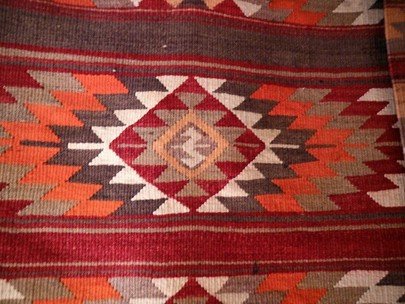
Jordan. Detail of Bedouin rug with tribe crest in the centre. Goat wool. Rightsof Paths of Jordan. Accessed via https://www.pathsofjordan.net/weaving
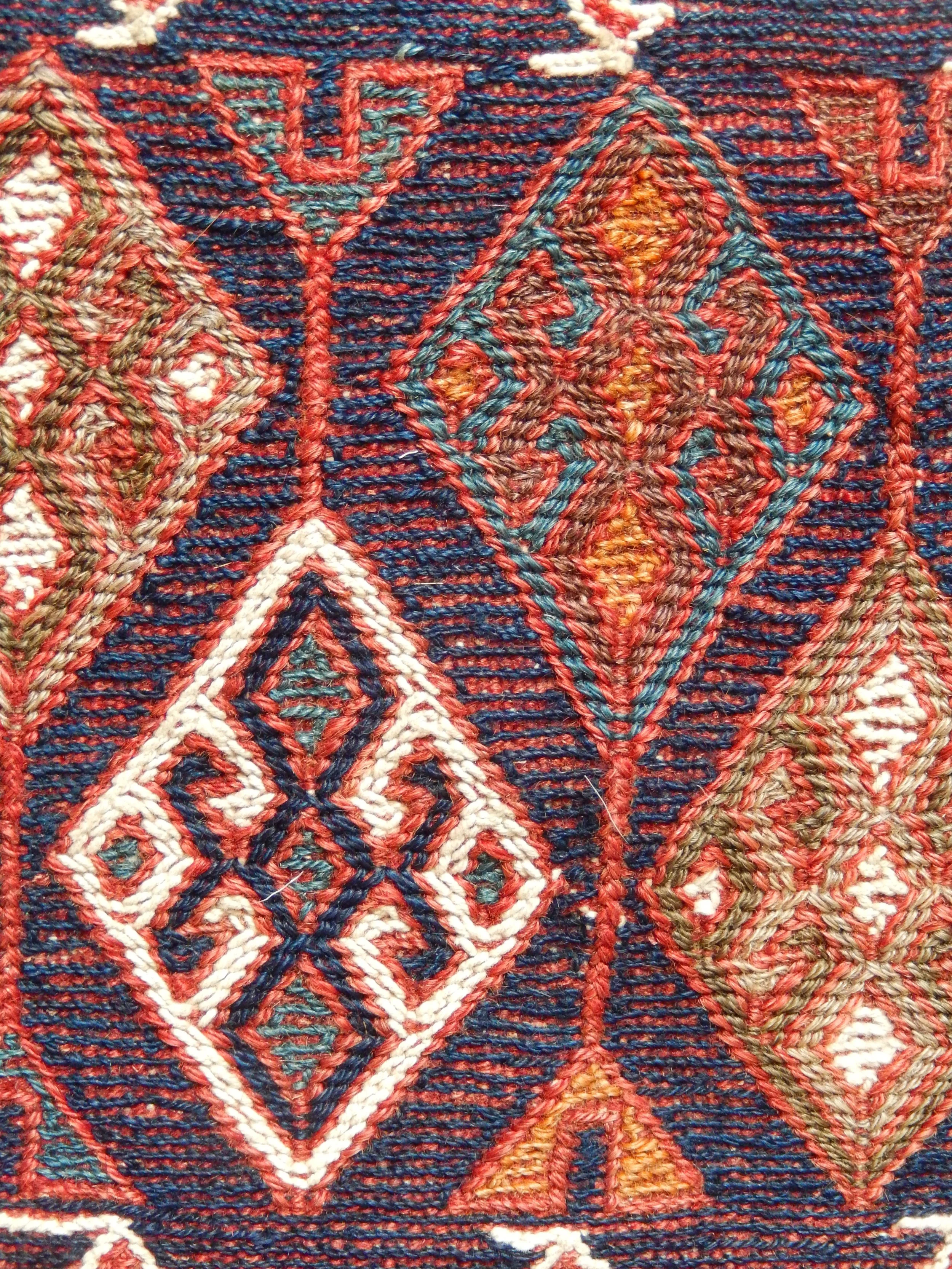
Iran. Luristan area. Detail of the motif on the front of the Soumak saddle bag. The Soumak weaving is visible. End of 20th century. Foto Ian Alexander. CC BY-SA 4.0. Accessed via https://commons.wikimedia.org/w/index.php?curid=46597453
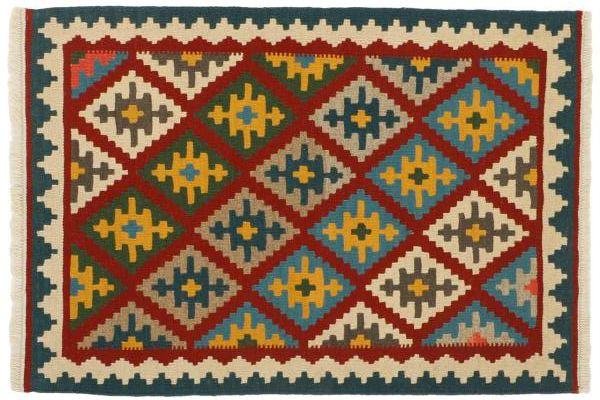
Iran. Qashqai tribes of the Fars Province. Wool. Rights of Pack to Iran. Accessed via https://packtoiran.com/blogs/detail/17/Iranian-kilims